
Can You Afford To ‘Ignore’ Data?
“Ignorance is bliss,” or so the old adage goes. At Innova-Harmonics, our goal is to educate members of industry that ignorance is not bliss. We’ve spoken with countless engineers in plants who want to know as much as possible so they can properly plan, operate, and improve their facilities. The sad truth is that the pool of people who can reliably turn raw data into actionable insight is shrinking, and worse, much of the data being collected today simply isn’t useful in practice.
That belief is what initially motivated the design of Octopus. We knew that machines already contain the data needed to motivate better design and operational decisions. The real question wasn’t whether the data existed, but which data actually mattered, and which signals were worth chasing. The answer to that question is what ultimately shaped the sensor layout we’ve implemented on the device.
What’s especially difficult about being an engineer in manufacturing is the constant need to divide your attention into buckets and prioritize only the problems that are easiest to access. All the while, there’s an unspoken expectation that when downtime becomes painful enough, it’s your fault for not paying close enough attention. We don’t believe engineers intentionally ignore their data, but we do believe modern sensors and control implementations make certain datasets incredibly inconvenient to find, correlate, or trust. This frustration isn’t unique to industry. It’s reflected directly in modern academic research on vibration analysis, where even researchers struggle to extract meaningful information from what is often a chaotic signal landscape.
“Modern predictive maintenance research consistently notes that vibration signals are complex, noisy, and highly sensitive to operating conditions, making single-signal interpretation unreliable even in controlled research environments.”
(Multi-Fault Diagnosis Of Industrial Rotating Machines Using Data-Driven Approach: A Review Of Two Decades Of Research, Gawde, Patil, et al.)
“Reviews of smart manufacturing systems identify fragmentation of sensor data pipelines and limited fusion strategies as a major barrier to extracting meaningful insight from industrial data.”
(A Review of Multisensor Data Fusion Solutions in Smart Manufacturing: Systems and Trends, Tsanousa, Bektsis, Kyriakopoulos, et al.)
Vibration on its own isn’t enough anymore. And yet, plants are still accustomed to making critical decisions using narrow, single-line data pathways. Engineers worth their salt know how to make calls that save plants real money, and they know how to justify those decisions with rigorous data. The problem isn’t the engineers. The problem is that data collection is often constrained by legacy control systems and outdated standards. Wouldn’t it be better if system maintenance, and the prevention of downtime, were driven by higher-quality, higher-context data from the start? We think so.
Take a look below. This figure comes from Multi-Fault Diagnosis Of Industrial Rotating Machines Using Data-Driven Approach: A Review Of Two Decades Of Research by Gawde, Patil, et al.:
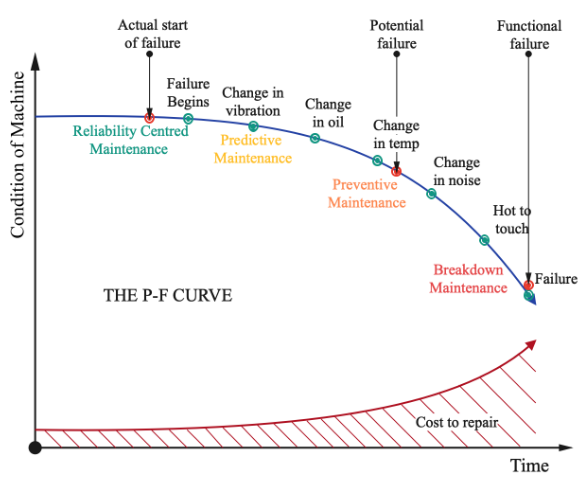
The goal, of course, is to identify the true “start of failure” within a machine, using techniques that are still largely novel to industry. Vibration analysis is only the beginning. Multi-modal approaches, where multiple data streams work in tandem to classify faults, offer far greater clarity. Now imagine going even further. Incorporating additional data streams into models that improve over time as they learn from real operation. Industry will adopt these technologies. The real questions are when, and how effective the implementations will be when they do.
Shouldering the responsibility of making decisions in a factory shouldn’t be a solitary burden. You can always hire more talent, but what if the mechanical problem you’re chasing is riddled with blind spots you can’t even see because the data context is too narrow? Would you knowingly take that risk?
In future blog posts, we’ll explore the evolution of maintenance strategies and the experiments that led to the academic discoveries discussed here. Stay tuned, leave a comment, or send us an email. We’d love to hear from you.
In conclusion, this is a tough job, and often an even tougher call. We want to hear from those facing challenges like these. If you’re interested in sharing your story, or discussing it on our blog or LinkedIn page, don’t hesitate to reach out:
nathaniel@innovaharmonics.com
 English
Leave a Reply